Email marketing: 5 automated emails that bring in sales
Automated emails you set up once, and they work for you every day. Here are the five every e-shop needs, when each one goes out, and what needs to be in place before you switch them on.
Why automated emails sell more
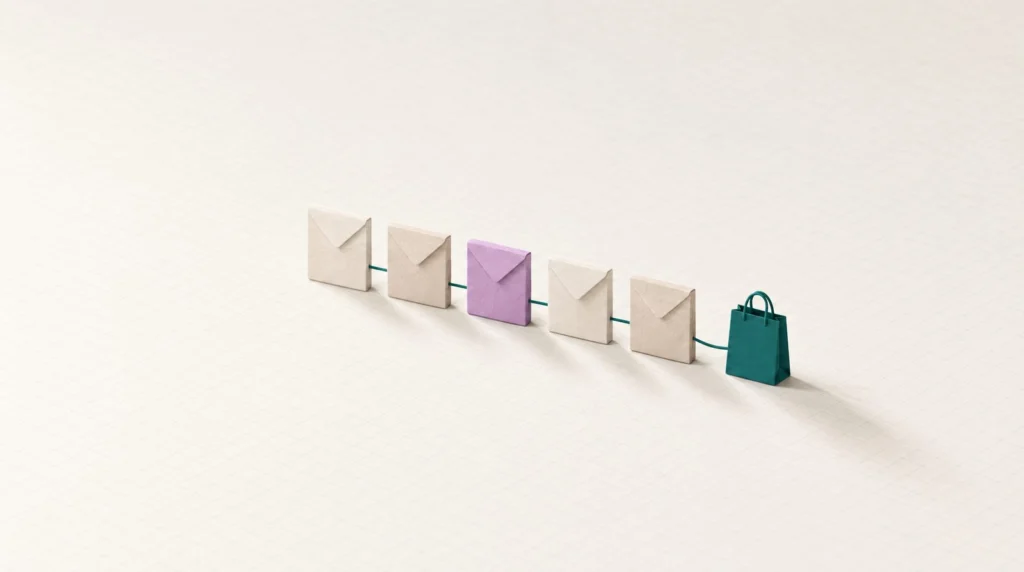
A newsletter goes out to your whole list at the same time. An automated email goes out when someone does something: joins your list, leaves a cart, completes a purchase. In other words, it arrives at the moment the message makes sense to them.
That’s why email marketing with automation punches above its weight. In Klaviyo’s 2026 data, automated emails are just 5.3% of all emails sent, but they bring in nearly 41% of email revenue. And you set them up once: after that, they work every day.
Before the first email: consent and deliverability
Consent. In Greece, marketing emails are covered by Article 11 of Law 3471/2006 and the GDPR. The basic rule is simple: you only send to people who have given explicit consent, with some exceptions for existing customers. Every email needs an easy way to unsubscribe, and you must be able to prove when and how each consent was given.
Deliverability. Since 2024 Google and Yahoo, and since 2025 Microsoft, have had strict rules for anyone sending a lot of email. Without the right technical settings on your domain, your emails risk landing in spam or not arriving at all, and you often only notice when results drop.
1. The welcome email
Someone has just entered their email on your website, so they remember you and are interested right now. In Klaviyo’s data, the welcome series is the second most profitable automation.
The simplest rule: the first email goes out immediately, not the next day. After that, a short series can introduce your shop and give the new subscriber a reason to make their first purchase.
2. The abandoned cart reminder
About 7 in 10 people who add something to their cart leave without buying (70.22% according to Baymard), most often because of extra costs, such as shipping, that only appear at checkout. It’s the most profitable automation in Klaviyo’s data.
A short series of reminders brings some of them back. When each email goes out, what it says and whether it carries an incentive make the difference between a reminder that sells and one that annoys. One sure mistake: a discount in the first email, because customers learn to leave carts on purpose.
It also needs legal care, because it’s a marketing email. The data protection authority of Hesse, in Germany, has found it illegal without consent for people who have never bought.
3. The post-purchase email
The easiest sale is the second one, to someone who already trusted you. Post-purchase emails build that relationship: they say thank you, ask for a review at the right moment and suggest the next purchase. The order confirmation, though, is a service message and stays clean, with no offers inside.
4. The email for what they viewed but didn’t buy
Someone looked at a product but didn’t add it to the cart. An email a few hours later, with that product and a few similar ones, gives them a reason to come back. It only works for subscribers your platform recognises and who have accepted cookies, and it needs restraint: the goal is a friendly reminder, not the feeling of being watched.
5. The win-back email
Every list has customers who stopped buying. The win-back email reminds them you exist, at the moment that fits the buying cycle of your products. It has a hidden benefit too: it helps you spot the people who are no longer interested, and a list without them reaches the inbox more easily instead of spam.
How to measure whether they work
Don’t judge your emails by open rate. Apple’s Mail app loads emails on the user’s behalf, and according to Litmus this affects more than half of all opens. In other words, the numbers are inflated.
What matters is what each automation sold, and seeing it in GA4 next to your other traffic sources. That’s the only way to know which email is worth improving first.
Email marketing FAQ
Which platform should I choose?
It depends on your e-shop, the platform it runs on, the size of your list and what you want to automate. Not every plan includes automation, so check before you commit. If you’re not sure, we can help you choose.
Do I need a big list for this to be worth it?
No. Automated emails work from your very first subscriber, because they only go out when someone does something. What matters is that they’re set up properly from the start.
Can I email a list I bought?
No. People on a bought list haven’t given consent to you, so sending is illegal and it also damages your domain’s reputation.
The idea behind the five automated emails is simple. The difference in sales comes down to the details: when each one goes out, what it says, who receives it and how it’s measured. At CNCTECH we set up automated emails for e-shops and businesses, from connecting your website or CRM to the copy, the consent and the tracking.